
1. Introduction to the Autonomic Nervous System (ANS)
Definition & Role
-
The ANS is the part of the peripheral nervous system that controls involuntary (automatic) physiological processes (such as heart rate, vascular tone, digestion, pupil size, respiratory rate) via efferent motor fibres.
-
It works by balancing two major functional divisions:
-
The Sympathetic nervous system (SNS) — “fight or flight” responses.
-
The Parasympathetic nervous system (PNS) — “rest and digest” responses.
-
-
The ANS uses specific receptors: adrenergic (α, β) for the SNS, and muscarinic & nicotinic for the PNS.
-
From a pharmacological perspective, many drugs act by mimicking or blocking these autonomic pathways (so-called autonomic agents).
Functional significance in pharmacology
-
Because virtually all organ systems (cardiovascular, respiratory, gastrointestinal, urinary, ocular) are influenced by autonomic tone, drugs working on the ANS are clinically very important (e.g., in hypertension, asthma, glaucoma, shock).
-
Understanding the ANS anatomy and receptor pharmacology helps predict both therapeutic effects and side-effects of many drug classes. Medicine LibreTexts+1
Brief classification of autonomic pharmacologic agents
According to major standard texts:
-
Cholinomimetics (parasympathomimetics)
-
Anticholinergics (parasympatholytics)
-
Adrenoreceptor agonists (sympathomimetics)
-
Adrenoreceptor antagonists (sympatholytics)
These categories often serve as the backbone for detailed drug classification.
2. Classification of Drugs Acting on the ANS

Here is a refined breakdown (relevant for your level) of the major classes of autonomic-acting drugs, focusing on the adrenergic side (since we’ll then focus on sympathomimetics & sympatholytics):
| Major class | Direction of effect | Primary receptors / mechanism |
|---|---|---|
| Sympathomimetics (adrenergic agonists) | Enhance SNS activity | α- and/or β-adrenergic receptor agonism; direct or indirect catecholamine release. UH Pressbooks+1 |
| Sympatholytics (adrenergic antagonists) | Inhibit SNS activity | Blockade or suppression of adrenergic (α, β) receptors OR inhibition of catecholamine release/storage. AMBOSS |
| Parasympathomimetics (cholinergic agonists) | Enhance PNS activity | Muscarinic / nicotinic receptor agonists |
| Parasympatholytics (cholinergic antagonists) | Inhibit PNS activity | Muscarinic receptor antagonists |
Because you asked specifically for sympathomimetic and sympatholytic agents, the remainder of this note will concentrate on those.
3. Sympathomimetic Agents (Adrenergic Agonists)
Definition & Mechanism
-
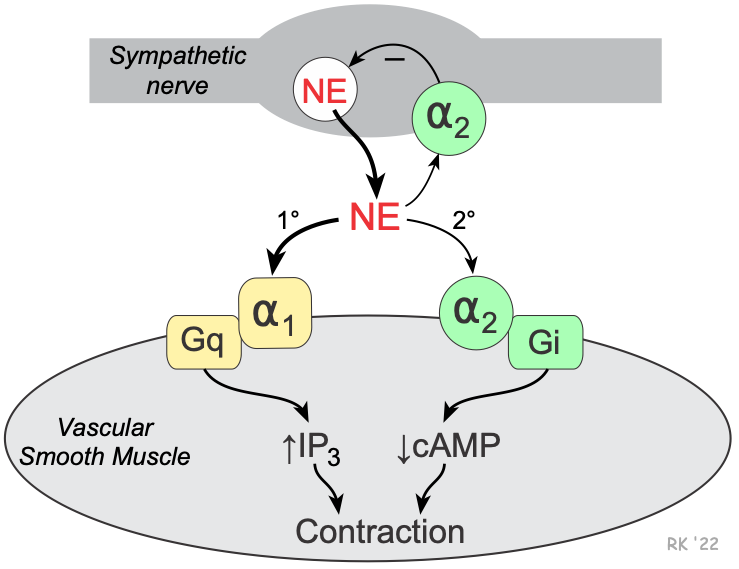
Sympathomimetic drugs are those that mimic or enhance the actions of the sympathetic nervous system (i.e., they mimic endogenous catecholamines like norepinephrine and epinephrine).
-
Mechanistically, they may act:
-
Direct-acting: bind and activate adrenergic receptors (α or β).
-
Indirect-acting: increase release or block re-uptake of endogenous catecholamines.
-
Mixed-acting: both mechanisms in one drug.
-
Classification of Sympathomimetics
Multiple approaches exist; one practical scheme for students:
A. By receptor selectivity
-
α₁-agonists (→ vasoconstriction, mydriasis)
-
α₂-agonists (presynaptic inhibition of NE release in some cases)
-
β₁-agonists (→ increases heart rate & contractility)
-
β₂-agonists (→ bronchodilation, vasodilation in skeletal muscle)
-
Dopaminergic (D₁/D₂) agonists (in some cases)
B. By mechanism of action
-
Direct acting
-
Indirect acting
-
Mixed acting
C. By therapeutic application (less important for classification but useful)
-
Bronchodilators (β₂ agonists)
-
Vasopressors / inotropes (α₁, β₁ agonists)
-
Decongestants (α₁ agonists)
-
CNS stimulants (some indirect sympathomimetics)
Pharmacologic Effects & Clinical Uses
-
Activation of SNS — e.g., increased heart rate & contractile force (β₁), increased BP via vasoconstriction (α₁), bronchodilation (β₂)
-
Useful in: shock/hypotension, anaphylaxis (epinephrine), asthma/COPD (β₂ agonists), nasal congestion (α₁ agonist)
-
Note: because they activate the SNS, side-effects reflect “over-drive” (tachycardia, hypertension, arrhythmias, etc).
Example Drugs
-
Phenylephrine (α₁-agonist decongestant/pressor)
-
Dobutamine (β₁-agonist inotropic agent)
-
Albuterol (β₂-agonist bronchodilator)
Student Tips / Clinical Correlations
-
When you hear “adrenergic agonist → SNS activation → increased HR/BP/bronchodilation”, think sympathomimetic.
-
Knowing the receptor subtype helps: e.g., β₂ agonist → bronchodilation → asthma; α₁ agonist → vasoconstriction → raises BP or nasal decongestant.
-
Beware indirect acting agents — they may have broader effects and higher risk of side-effects (e.g., CNS stimulation).
-
In exam/clinical context: recall that if you give a sympathomimetic, you increase sympathetic tone; conversely blocking the SNS is the domain of sympatholytics (below).
4. Sympatholytic Agents (Adrenergic Antagonists)
Definition & Mechanism
-
Sympatholytic drugs are those that inhibit or block the sympathetic nervous system – also called anti-adrenergic agents.
-
Mechanisms involve:
-
Receptor antagonism: α-blockers, β-blockers (prevent NE/epinephrine action).
-
Inhibition of catecholamine synthesis/storage/release: e.g., drugs reducing NE release from nerve terminals.
-
Central sympathoinhibition: drugs acting on CNS to reduce sympathetic outflow (e.g., α₂-agonists acting presynaptically).
-
Classification of Sympatholytics
A useful classification for your level:
-
Peripheral adrenergic antagonists
-
α₁-blockers (reduce vasoconstriction)
-
α₂-blockers (rare clinically)
-
β₁- and β₂-blockers
-
-
Drugs interfering with catecholamine release/storage
-
e.g., Reserpine (depletes NE)
-
-
Centrally acting agents
-
α₂-agonists (paradox: act to reduce SNS output) such as Clonidine
-
Pharmacologic Effects & Clinical Uses
-
Decrease SNS tone: lower heart rate (β₁), reduce BP (α₁ blockade reduces vasoconstriction), reduce cardiac output, etc.
-
Clinical uses include: hypertension, angina, arrhythmias, benign prostatic hyperplasia (via α₁-block), anxiety (some β-blockers)
-
Side-effects: bradycardia, hypotension, bronchospasm (β₂ blockade), orthostatic hypotension (α₁ blockade), fatigue.
Example Drugs
-
Prazosin (α₁-blocker – used in hypertension, BPH)
-
Propranolol (non-selective β-blocker)
-
Atenolol (β₁-selective β-blocker)
Student Tips / Clinical Correlations
-
If a drug is described as “adrenergic blocker” or “anti-adrenergic” in exam, it is a sympatholytic.
-
Remember reflex responses: e.g., if you block α₁ → vasodilation → you might get reflex tachycardia. That links to side-effects.
-
In clinical scenarios: if patient has hypertension + tachycardia, a β-blocker might help both; but if asthma present, beware β₂-blocker caution.
-
For BPH with hypertension: α₁-blocker (e.g., prazosin) useful because it relaxes prostate smooth muscle and reduces BP.
5. Summary Table for Quick Revision
| Drug Class | Primary Action | Representative Receptors | Clinical Use | Key Side-Effects |
|---|---|---|---|---|
| Sympathomimetics | ↑ SNS tone | α, β agonism | Asthma, shock, decongestion | Hypertension, tachycardia, arrhythmia |
| Sympatholytics | ↓ SNS tone | α, β antagonism or NE release ↓ | Hypertension, angina, BPH | Bradycardia, hypotension, bronchospasm |
6. Key Points/Clinical Application (for your PhD-cardiometabolic health focus)
-
In cardiometabolic health, manipulation of the SNS is critical: e.g., β-blockers reduce cardiac workload and improve outcomes in heart failure; α₁-blockers may improve vascular tone.
-
Recognising that sympathomimetic drugs may worsen hypertension, arrhythmias, or ischemia is important in vulnerable patients.
-
In metabolic disease (e.g., diabetes, obesity), sympathetic overactivity (and parasympathetic underactivity) may play a role; thus sympatholytics may have beneficial roles beyond BP control (though this is complex).
-
Always correlate receptor pharmacology with clinical situation: what receptor does drug act on, what is the downstream organ/tissue effect, what are possible compensatory responses/reflexes?

